Giant draughts hire Scotland is a firm favourite for weddings, corporate days and garden parties across the country. Giant Draughts — also known as Giant Checkers — is one of the most recognisable and immediately accessible garden games we offer. Everyone has played draughts at some point, which means guests of all ages get stuck in straight away without needing any explanation. The giant version brings the classic game to life on a scale that draws people in from across the room.
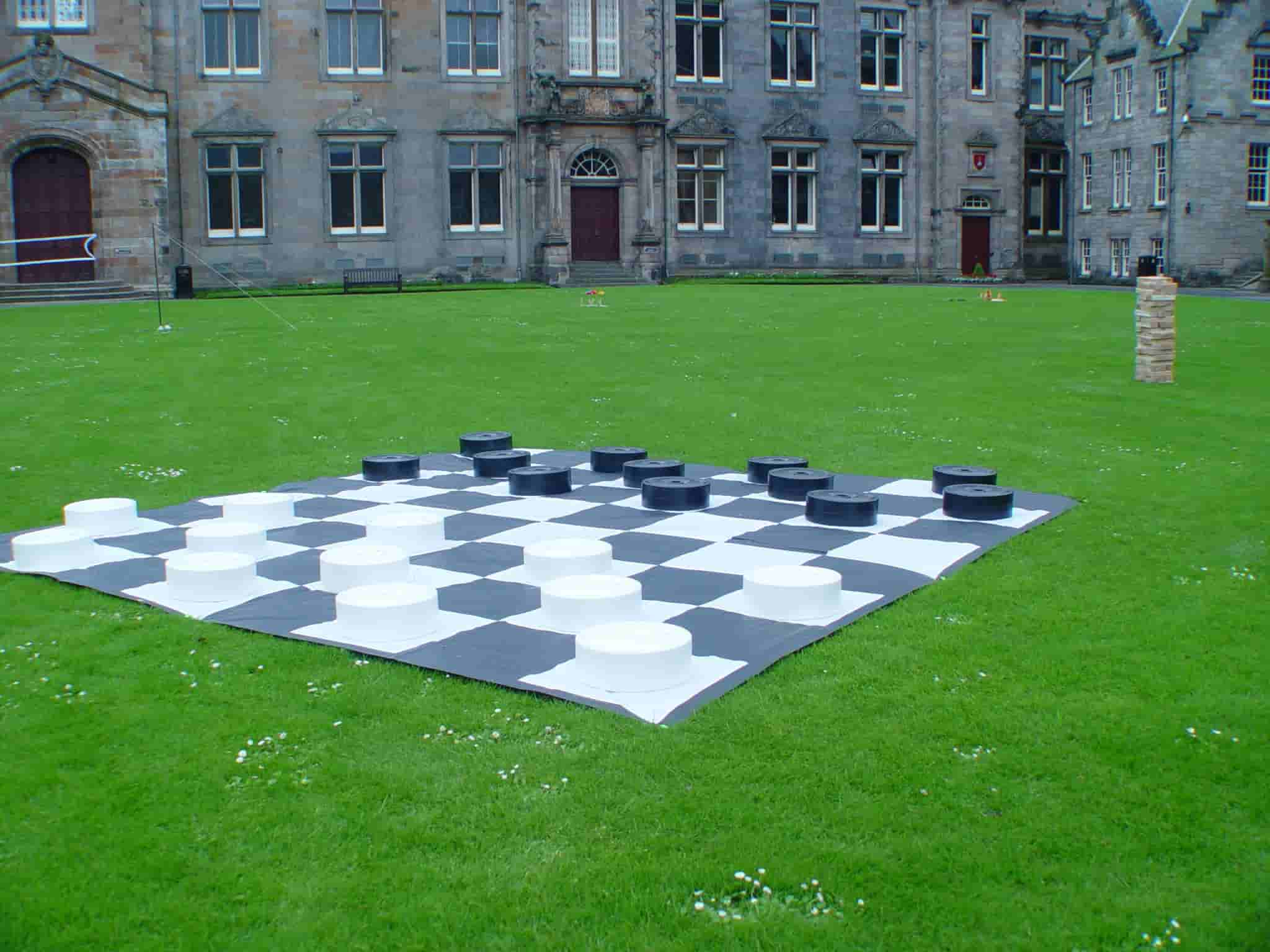
Giant Draughts works particularly well at wedding drinks receptions, garden parties, and corporate events. It’s sociable and competitive without requiring too much space. The game is compact enough to fit comfortably in most indoor or outdoor event spaces, and pairs brilliantly with other games from our giant games hire range.
What’s Included
Every giant draughts hire Scotland booking includes delivery and collection to your venue across Central Scotland, a full set of oversized draughts pieces in red and black, and the playing board. Setup takes only a few minutes, and we’ll position it wherever works best for your event layout.
Giant Draughts Hire Scotland: A Beginner’s Guide to the Rules
A quick note on names: in Britain, people call the game draughts; in America, they call the very same game checkers. They’re identical — same board, same pieces, same rules — so wherever you see “checkers” written, read “draughts.”
By the end of this guide you’ll know how to set the board, move and capture, crown a king, and play the handful of ideas that separate a winner from a loser. No jargon, no fluff — just the rules and the thinking behind them.
| 8×8 Squares on the board | 32 Dark squares in play | 12 Pieces per player | 64 Total squares |
| 2 Players | 12th C. Modern form emerged, France | 1 Direction ordinary pieces move | Compulsory Capturing rule |
The Board and the Setup
Draughts is played on a standard 8×8 board — the very same board used for chess, with sixty-four squares in alternating light and dark. Only the thirty-two dark squares are ever used. Every piece sits on a dark square and every move stays on the dark squares, which is why the whole game travels diagonally.
Each player takes twelve pieces of one colour — traditionally one set black, one set white or red. Place your twelve pieces on the dark squares of the three rows nearest you, filling them completely. That uses all twelve and leaves the two centre rows empty as no-man’s-land between the armies.
Sit so you have a dark square in your near-left corner; that orients the board correctly. The darker pieces conventionally move first. Once both sides are set, the middle is bare and the two front ranks face each other across the gap.
The game is old. It descends from an ancient game called Alquerque. The modern form — played on a chess-style board — emerged in France around the 12th century, so the shape on your table tonight is roughly nine hundred years old.
How the Pieces Move
An ordinary piece — often called a “man” — moves one square diagonally forward onto an empty dark square. That’s the whole rule for ordinary movement: one step, diagonally, forwards, into an empty square. Ordinary pieces cannot move sideways, cannot move straight, and cannot move backwards.
Because everything stays on the dark squares, a piece always has at most two simple moves available: forward-left or forward-right. If a square is blocked by another piece — yours or your opponent’s — that direction is closed unless a capture is possible there instead.
Players alternate turns, moving one piece per turn. There’s no rolling of dice and no element of chance. Draughts is a game of pure information, with everything visible on the board in front of you. However, the skill lies entirely in choosing which of your pieces to advance and when.
Capturing — and Why It’s Compulsory
Capturing is the engine of the game. If one of your pieces sits diagonally next to an opponent’s piece, and the dark square immediately beyond that piece is empty, you may jump over it. Simply hop diagonally into the empty square and remove the jumped piece from the board.
The best part is the chain. If, after landing, your same piece can immediately jump another opponent piece, it must continue. It keeps going for as long as further jumps are available, so a single turn can sweep two, three, or more enemy pieces off the board in one flowing move. These multi-jumps are how games swing in an instant.
Here’s the rule that catches every beginner: in English draughts, capturing is compulsory. However, if a capture is available to you, you must take it — you’re not allowed to make a quiet move instead. Where two different captures are on offer, you may choose which to take, but take one you must.
As a result, this single rule turns the game from gentle to sharp. If you leave a piece where your opponent can capture it, they will, so you learn to offer a piece only when the forced reply leaves you better off. It’s the heart of draughts tactics.
Getting Crowned: Kings and Backward Movement
When one of your ordinary pieces reaches the far edge of the board — the row of dark squares closest to your opponent, called the king row — it gets promoted. You crown the piece, traditionally by stacking a second captured piece of the same colour on top so it stands taller than the rest.
A king is far more powerful than an ordinary man. It may move and capture diagonally in both directions — forwards and backwards — while ordinary pieces are still locked into moving forward only. A king can therefore chase, retreat, and set up jumps from angles an ordinary piece can never reach.
Crucially, a piece that reaches the king row ends its move there even if it arrived by a jump. It cannot continue capturing on the same turn you crown it. From your next turn onward, however, the king roams freely in all four diagonal directions.
Racing a piece to the king row is one of the great goals of the game. A single king can turn a losing endgame into a win. That’s why protecting your back row — and stopping the enemy reaching theirs — matters so much.
How to Win
You win at draughts by capturing every one of your opponent’s pieces, or by leaving them with no legal move on their turn — both count as a win. It’s exactly this simple, satisfying win condition that makes giant draughts hire Scotland such a popular pick for guests who’ve never played before.
A Few Strategy Tips for Beginners
Whether you’re planning a giant draughts hire Scotland booking or just want to sharpen your own game first, these tips will help:
- Control the centre. Pieces in the middle of the board command more squares and more diagonals than pieces stranded on the edge. Push toward the centre early and you dictate where the captures happen. A piece sitting on the side rail is safe but passive — it does half the work.
- Hold your back row. The two pieces guarding your king row stop the enemy from crowning. Keep them home as long as you sensibly can; every turn an opponent fails to make a king is a turn you stay level. Give up the back row only when you gain something clearly bigger.
- Use compulsory capture against your opponent. Because a capture must be taken, you can offer a single piece to force a reply that opens a bigger jump for you — a two-for-one trade. Trading pieces when you’re ahead simplifies toward a won endgame; avoid trading when you’re behind.
- Teaching a child? Slow this down and let them spot the forced jump themselves — the strategy lands far better than any lecture.
Frequently Asked Questions About Draughts
How do you play draughts?
Two people play draughts on a standard 8×8 board, using only the thirty-two dark squares. Each player starts with twelve pieces on the dark squares of their nearest three rows. You take turns moving one piece one square diagonally forward onto an empty dark square. To capture, you jump diagonally over an adjacent opponent piece into the empty square beyond and remove it — captures are compulsory, and you can chain them. A piece reaching the far row becomes a king and can move backwards too. You win by capturing all the opponent’s pieces or leaving them with no legal move.
How many pieces do you start with in draughts?
Each player starts with twelve pieces, so there are twenty-four pieces on the board at the start of a game. You place them on the dark squares of the three rows nearest each player, filling all twelve dark squares in those rows and leaving the two central rows empty between the two sides.
What is the difference between draughts and checkers?
There is no difference in the game itself — “draughts” is simply the British name and “checkers” is the American name for exactly the same game. Both are played on an 8×8 board using twelve pieces each on the dark squares, with the same diagonal movement, the same compulsory capturing, and the same king promotion on the far row.
Do you have to take a piece in draughts?
Yes. In English draughts, capturing is compulsory: if a jump is available to you on your turn, you must take it rather than making an ordinary move. If more than one capture is possible, you may choose which one to make, but you cannot decline to capture altogether. Once you’ve jumped a piece, if that same piece can immediately jump again you must continue capturing until no further jumps are available.
How do you get a king in draughts?
You get a king by moving one of your ordinary pieces all the way to the far edge of the board — the king row, closest to your opponent. As soon as a piece lands there, it’s crowned, traditionally by stacking a second piece of the same colour on top. The move ends as soon as the piece is crowned, even if it arrived by a capture. From your next turn, that king can move and capture diagonally both forwards and backwards.
More Draughts Questions
Can a king move backwards in draughts?
Yes. A king can move and capture diagonally in both directions — forwards and backwards — which is what makes it so much stronger than an ordinary piece. Ordinary pieces, by contrast, can only ever move forward one diagonal square and can only capture in the forward direction.
How do you win at draughts?
You win at draughts in one of two ways: capture every one of your opponent’s pieces, or leave your opponent with no legal move on their turn — if all their remaining pieces are blocked and cannot move or capture, they lose even though pieces remain on the board.
What board do you play draughts on?
Draughts is played on a standard 8×8 board — the very same sixty-four-square board used for chess. Only the thirty-two dark squares are used in play. Because the boards are identical, a single wooden chessboard doubles as a draughts board.
Where did draughts come from?
Draughts descends from a much older board game called Alquerque. The modern form — played on a chess-style 8×8 board — emerged in France around the 12th century. From France the game spread across Europe and into Britain, where it became known as draughts, and is the same game sold worldwide today as checkers.
Is draughts good for children to learn?
Yes — draughts is one of the best first strategy games for children, often suitable from around age five. The rules are simple enough to learn in a minute, but the game quietly teaches planning, cause-and-effect, and patience, since every move is fully visible with no luck involved. Compulsory capturing gives children a clear pattern to spot, and crowning a king is a satisfying goal to work toward.
Giant Draughts Hire Scotland: Book for Your Event
We deliver giant draughts hire Scotland to events across Central Scotland — including Edinburgh, Glasgow, Perth, Fife, the Lothians, Stirling, and the Scottish Borders. If you’re looking for more background on the game of draughts, Wikipedia covers the history and rules in full. And if you’d like to add Giant Draughts to your event alongside DJ services, get in touch for a combined quote.
Giant Draughts Hire Scotland FAQs
Is Giant Draughts suitable for indoor and outdoor use?
Giant Draughts works indoors or outdoors on most surfaces. For outdoor Scottish events we recommend a covered backup area in case of weather.
What events is Giant Draughts hire popular for?
Giant Draughts is a great choice for wedding drinks receptions, garden parties, corporate events, and family celebrations. No experience is needed — guests get involved straight away.
What areas of Scotland do you cover for Giant Draughts hire?
We deliver across Central Scotland — Edinburgh, Glasgow, Perth, Fife, East Lothian, Midlothian and West Lothian, Stirling and the Scottish Borders. Get in touch to confirm availability for your date and venue.
Can Giant Draughts be combined with DJ or other entertainment?
Yes — games and DJ services are frequently booked together. See our full giant games range or get in touch for a combined quote.